


Canton Fair 2026 Honey Dispenser ODM Cases: From Base Model to Branded Kitchen Sets
At the 2026 Canton Fair, the honey and syrup section at Aelga's booth carried a product line rather than a single item: a proven base model, the decoration and packaging developed on it, the re-engineered MARK honey dispenser built from the same core structure, and the coffee-corner collection extended from the MARK series. Three buyer conversations at the show surfaced different cooperation opportunities within that existing product line. A grocery brand was interested in the base model's existing color-extension options and discussed applying the related colorways to its own product line. A gift brand was drawn to the existing decal-firing finish and the gift-boxed version, and explored using them in a branded gift series. A U.S. coffee-chain buyer was interested in the MARK series and discussed developing a coordinated companion set for its brand based on the existing range. In each case the buyer started from an existing product solution rather than a blank-slate custom request, and each found its own entry point on the same lineage. This article follows that lineage step by step: what was developed on the base model, how the MARK honey dispenser reuses the core with a new exterior, and how the series became a coordinated coffee corner.
A Proven Base Model to Develop From
The lineage starts where most customization programs start: a base model that is already in the market and already works. Aelga's press-top Honey Dispenser is that base. The borosilicate body takes heat without holding odor across honey, maple syrup, chocolate, and caramel; the press-pump format gives a measured pour; the cross silicone mouth opens under pressure and closes on release; and the silicone seal cap keeps the unit closed between uses. None of these parts is new or experimental, and that is exactly the point. For a buyer, a mature base model means the parts that touch the food are settled, and every step that follows changes the look, the surface, or the packaging rather than re-risking the core. At the show, the base model was the first thing buyers picked up, and it stayed the reference point. It is the first entry in the full honey and syrup dispensers range.
Process Development on the Base Model
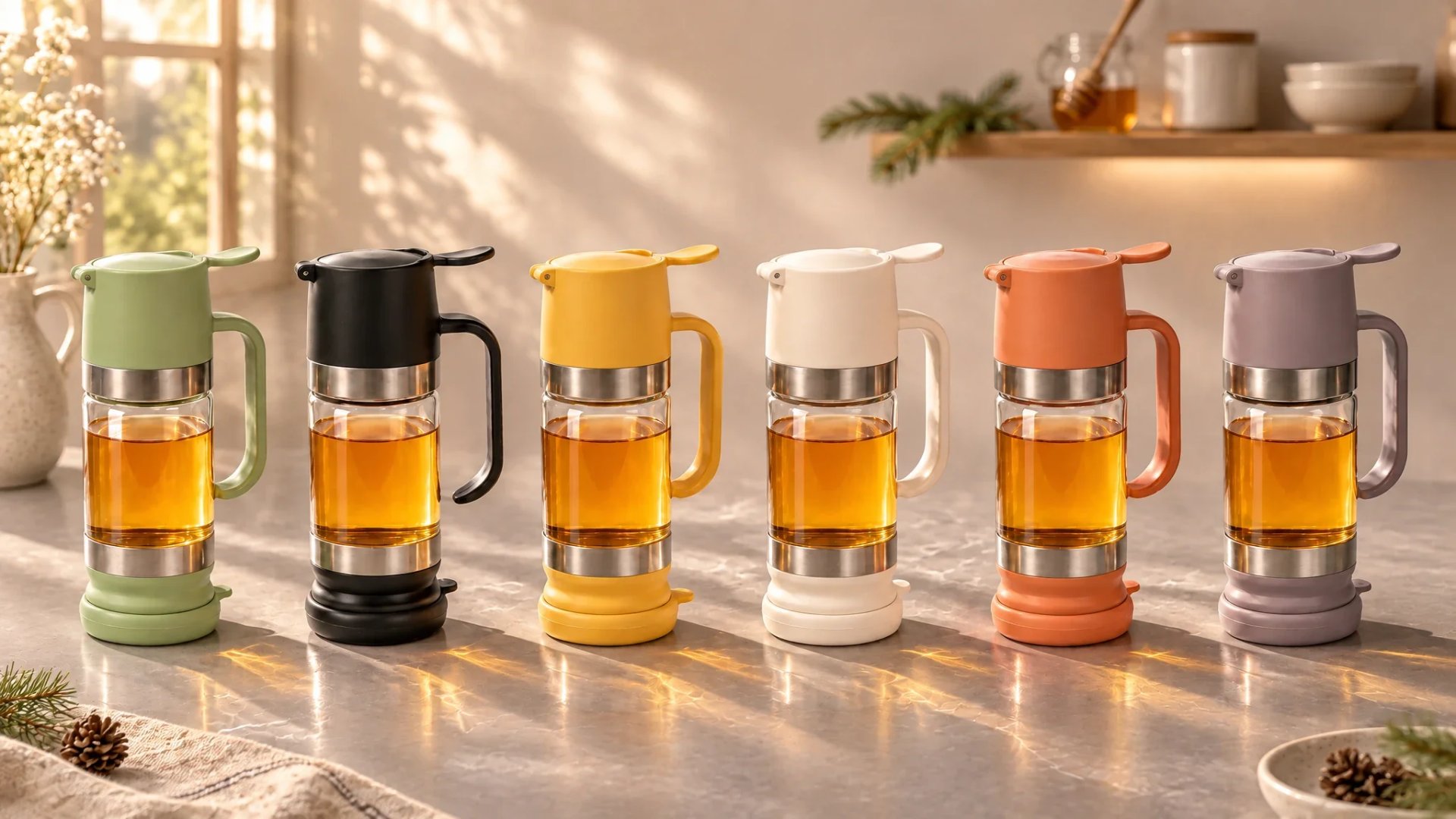
Development on the base model happens in sequence, and each step is a separate production capability. The first is SKU color change: the same bottle, the same pump and seal, new coating colors. At the Canton Fair, a grocery brand was interested in the existing color-extension options and discussed adjusting this honey dispenser to a matte grey and cream finish so it could be folded into the brand's own product line. The second is the decal-firing process: fired decorative patterns applied to the glass itself, so the accent is part of the surface rather than a sticker or a label. The third development stage introduced a glass-bee embellishment, attached to the bottle through a specialized firing process, adding a distinctive three-dimensional detail to the original design. Following these decorative developments, Aelga further expanded the base model into gift-ready packaging: the decorated bottle presented in a gift box, and later paired with a matching kitchen set so one box could carry a full countertop story. At the 2026 Canton Fair, these existing decorated and gift-boxed options attracted interest from a European gift brand, which explored how they could be adapted into its own branded gift collection. All of these surfaces sit on the outside of the glass, and the food-contact surface stays the original borosilicate. Aelga's gift and bundle sets platform is built for this step: same product family, upgraded box, and one shipment instead of three.
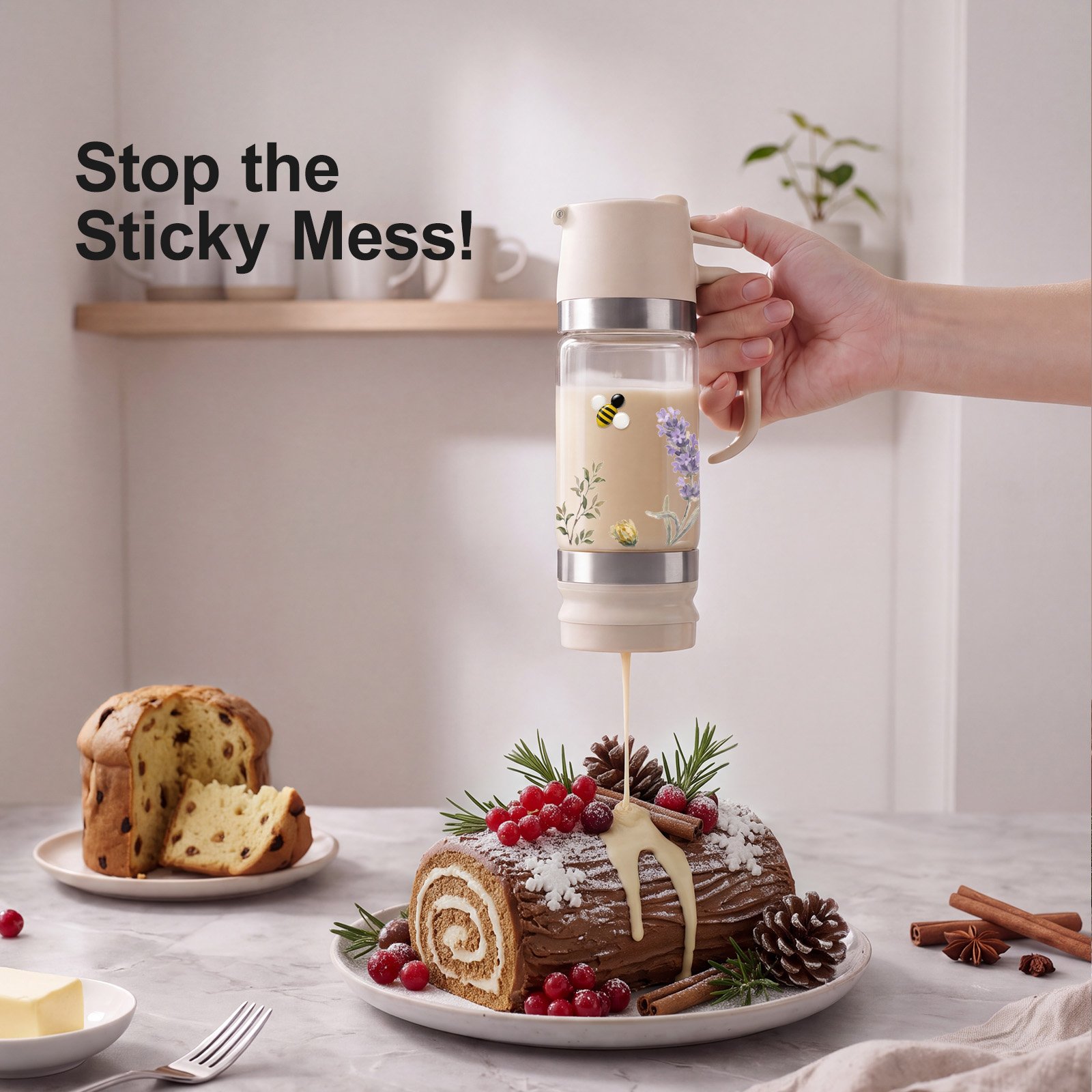
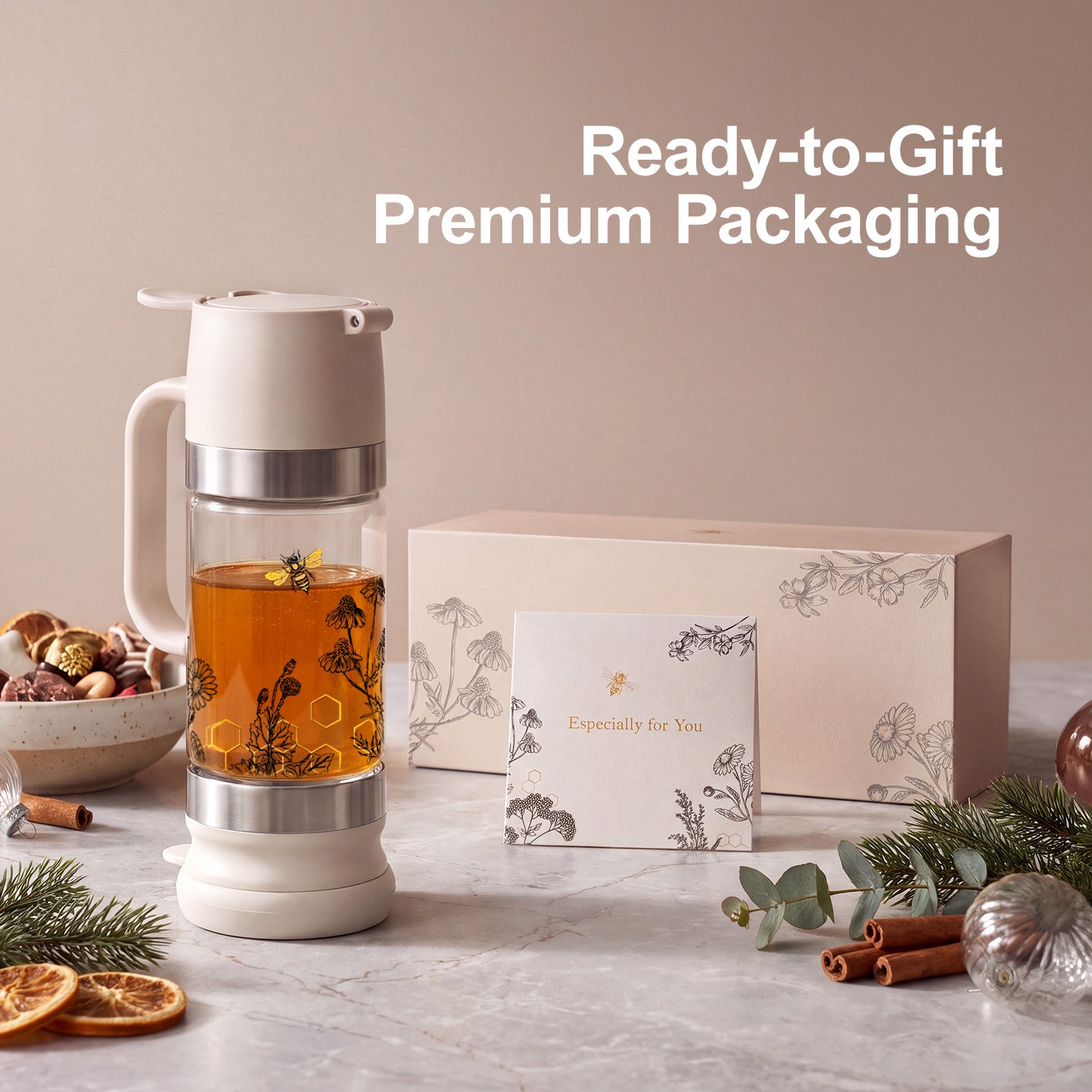
For a buyer, a mature base model is a solid starting point for further product expansion. By keeping the core structure of the base product, the line can be extended through color, surface decoration, and packaging form to suit the needs of different brands and sales channels.
Reusing the Core, Redesigning the Exterior: The MARK Honey Dispenser
The next step is not another finish on the base model; it is a new product built from the same engineering. The MARK honey dispenser reuses the internal core structure that matured on the base model: the press-pump control and the sealing parts that make the pour measured and the unit drip-free. Everything around it is rebuilt. Building on Aelga's mature internal structural solutions, the MARK honey dispenser introduces a completely redesigned exterior that integrates stainless steel and borosilicate glass. Its appearance does not reuse the original base model's form, but follows the coordinated visual language of the MARK series. One point matters for buyers: the MARK family does not put one shared functional structure into every product. The honey dispenser carries the press-pump core; the other pieces are each engineered for their own use case. What unites the series is the design language, not a single mechanism.
From the MARK Series to the Coffee Corner
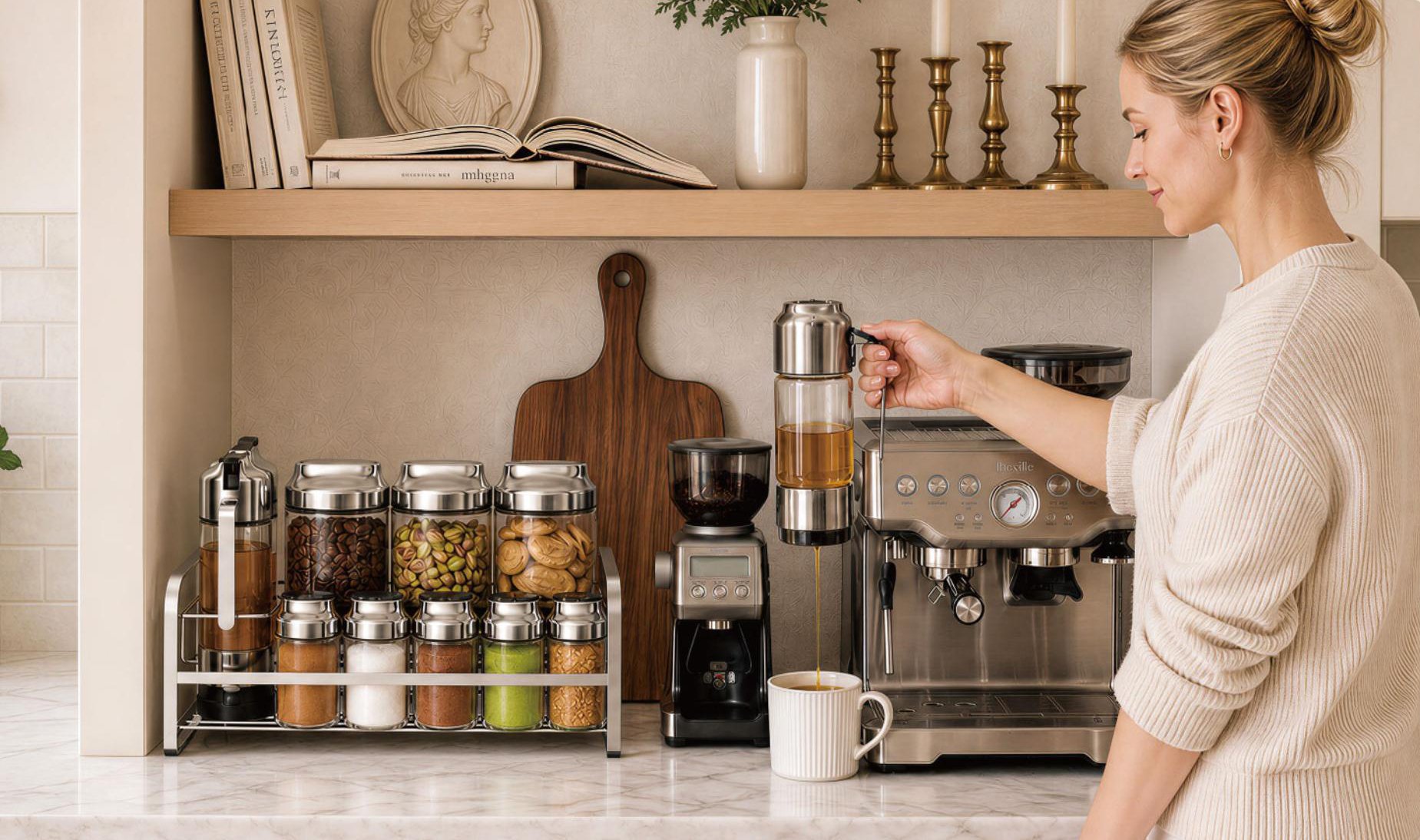
With the MARK honey dispenser finalized, the platform can be assembled into multi-item scenario-focused kits. The coffee-corner set is an extension of Aelga's existing MARK series. At the Canton Fair, a U.S. coffee-chain buyer showed particular interest in this 3+5+2 combination: three storage jars for coffee beans and other dry goods, five seasoning bottles for powders such as cinnamon, ginger, coffee powder, and matcha, and two MARK honey dispensers with their glass-and-stainless-steel design.
The discussion also explored another branded set, combining the MARK honey dispenser with a sugar-and-milk jar, a cheese jar, and seasoning bottles. The combination brings together products for beverage preparation, breakfast, baking, and seasoning, giving the buyer another option for developing a branded product set.
Each product is designed for its own function, while shared design details, matte finishes, and material combinations give the MARK series a recognizable look. The range can therefore be combined in different ways for home coffee corners or commercial settings, such as coffee shops and beverage stations.
What the Three Conversations Actually Prove
Taken together, the three conversations show different channels putting different demands on product development, and they also show that Aelga's existing product solutions can offer an entry point for different projects. A grocery brand can start from the color extension of a mature model; a gift brand can develop decorative finishes and gift-set packaging; and a coffee-chain customer can build a coordinated scenario set based on the MARK series. The confidence behind these options comes from a development capability that goes beyond single products: Aelga can add new colorways and decorative finishes to existing models as derivative versions; carry a proven internal structure into a product with a redesigned exterior; and use a unified design language to build a multi-piece coordinated series. A buyer can choose the development direction that fits its own brand and sales channel, without re-developing everything from scratch for each project. The full scope of Aelga's OEM/ODM services describes how each of these directions is executed in production.
How an ODM Honey Line Starts
An ODM project starts with a full understanding of the buyer's target market, sales channels, and product needs. On that basis, the project direction can be set: develop on the existing honey dispenser, add new colorways or surface decoration, redesign the exterior, or build a coordinated multi-piece series. Once the product direction is set, Aelga and the buyer work out the development scope together, covering the product's appearance, color, decorative finish, materials, and packaging. For a multi-category combination project, the two sides also agree on the product combination list and the design, surface-treatment, and material logic that keeps the whole series consistent. In the next stage, once the development plan is fixed, a sample is made to confirm the product's appearance, configuration, and related details. After that, the minimum order quantity and lead time are set according to the selected products, the customization requirements, and the order information. Whether a project extends new colors on an existing base model or scales up to a full MARK series set, the development scope is set around the buyer's real market and product needs. The factory is certified to ISO 9001, ISO 14001, and ISO 45001, and Aelga has accumulated more than 100 design and utility model patents, while its original product designs, including the MARK series, have received international design recognition. For buyers starting from the base, the full honey and syrup dispensers range is the natural first stop.
Conclusion
The honey dispenser at the Canton Fair was not one product with three finishes; it was a development lineage shown in public. A proven borosilicate base model, developed through color, fired decoration, glass-bee application, and gift packaging; the same core structure reused in a re-engineered exterior as the MARK honey dispenser; and the MARK series extended into a coordinated coffee corner for the channels that asked for it. Different buyers showed interest in different parts of Aelga's existing product range and discussed projects suited to their own needs. This development journey demonstrates Aelga's ability to build on mature products, introduce new manufacturing processes, reuse proven core structures where appropriate, create differentiated exterior designs, and develop coordinated multi-material product collections for different market needs.
Frequently Asked Questions
Q: Why is a press-pump honey dispenser preferred over a squeeze bottle?
A: The press-pump format gives a measured pour and stops cleanly on release. The cross silicone mouth and the silicone seal cap keep that behavior consistent in production, where a squeeze bottle's variable force does not.
Q: Do exterior decorations change the food-contact surface?
A: No. Fired decoration and the glass-bee embellishment are applied to the exterior of the glass body, leaving the original interior food-contact surface unchanged.
Q: What is the MOQ and lead time for a customized honey dispenser line?
A: Both depend on the configuration: base model, added colors and decoration, the MARK series, or a full coffee-corner kit. Aelga states the quantity and lead time per order during sample confirmation.
Q: Can a buyer start with the base model and move to the MARK series later?
A: Yes. The MARK honey dispenser reuses the core structure that matured on the base model, with a redesigned exterior, so the two directions can sit in one range without re-developing the core.