


How to Choose a Honey/Syrup Dispenser: No-Drip Press Control for Breakfast, Baking, and Coffee Bars
A good honey dispenser makes thick liquids easier to control, cleaner to serve, and simple to monitor. For breakfast, baking, and syrup service, the useful combination is one-hand press control, a silicone outlet, a clear glass body, and a form that fits surrounding kitchenware. Aelga's design lets the user press to release honey or syrup and release the control when serving is complete.
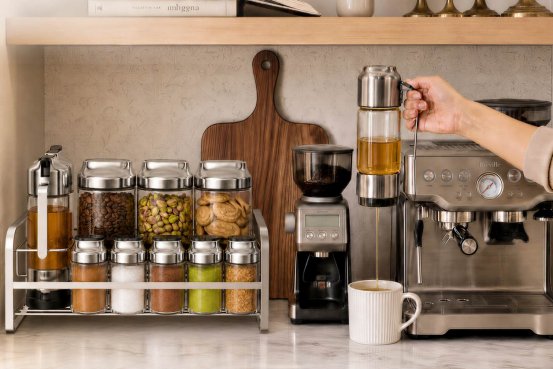
Why Traditional Honey Serving Creates Mess
Honey, maple syrup, chocolate sauce, and caramel sauce can cling to spoons, jar rims, and serving surfaces. During breakfast, dessert, coffee, or tea preparation, uncontrolled flow can also make portioning less predictable.
A dispenser with a controlled outlet helps direct the liquid where it is needed and reduces the amount left around the rim, plate, or countertop. For repeated use, this simple change can make serving cleaner and easier to manage.
How a Honey Dispenser Improves Flow Control
One-Hand Press Operation
A press-type honey dispenser allows the user to start and stop the flow with one hand. Press the control to dispense honey or syrup over toast, fruit, pancakes, waffles, bowls, or desserts, then release it to stop. This short operating movement is useful when the other hand is holding a plate, whisk, spoon, or other serving utensil.
Cross-Shaped Silicone Outlet
Aelga's honey dispenser uses a cross-shaped silicone slit at the bottom of the container. The slit opens under pressure and closes as the pressure is released, supporting a more measured flow than an uncovered opening. The outlet is designed around the behavior of thick liquids, so the serving action feels closer to a controlled squeeze than an uncertain pour.
The outlet should still be kept clean and checked during routine use. Thickness, temperature, residue, and the speed of pressing can affect how any syrup or sauce flows. For that reason, the best way to assess a press-type honey dispenser is to test it with the actual contents and the serving motion expected in the kitchen.
High-Borosilicate Glass for Easy Monitoring
The transparent body makes the remaining honey or syrup easy to see, helping users judge when refilling is needed.
Aelga's honey dispenser uses high-borosilicate glass. In addition to making the fill level visible, the transparent container lets the contents become part of the overall presentation. This can be useful on a home countertop, breakfast table, coffee bar, restaurant table, or coordinated kitchenware display.
Where a Honey Dispenser Works Best
Breakfast Tables and Home Kitchens
For breakfast tables and everyday kitchens, a honey dispenser is particularly useful for repeated small servings. Honey or syrup may be added to toast, yogurt, oatmeal, fruit, tea, pancakes, or waffles. A visible glass body makes the contents easy to identify, while press control keeps the serving process quick and straightforward.
Baking and Dessert Preparation
Baking and dessert preparation often require a different type of control. A cook may need a narrow stream over a bowl, a small amount across a finished dessert, or several repeated portions during preparation. A responsive outlet can reduce unnecessary wiping and help keep attention on the food rather than the container.
Coffee Bars, Restaurants, and Hotel Breakfast Areas
In professional service, a dispenser has to work for more than one person. The control should be obvious, the base should remain stable during ordinary use, and the outside should be easy to keep presentable. A compact glass-and-silicone format can suit a coffee bar, dessert counter, hotel breakfast area, or restaurant table.
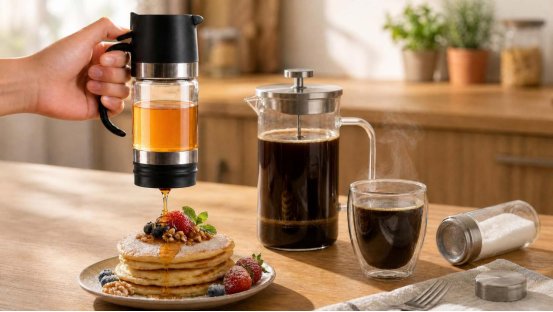
How Aelga Develops One Honey Dispenser into a Complete Kitchenware System
A honey dispenser can solve one very specific problem, but product development does not necessarily need to stop with a single SKU.
Aelga's approach becomes more interesting when the honey dispenser is considered as the starting point for a broader kitchenware system.
Start with a Functional Product
The first step is solving a clear serving problem.
For the honey dispenser, that means controlling sticky liquids more cleanly through a combination of one-hand press operation, a silicone outlet, and a transparent glass body.
Once that function works, the next question is not simply how to create another honey dispenser. The product can also be evaluated in terms of its proportions, materials, structure, countertop appearance, and relationship with other kitchen accessories.
This moves development from a single functional object toward a coordinated family of products.
Refine the Structure and Bring It into the Mark Series
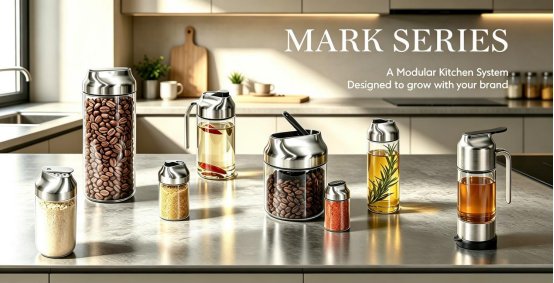
As the concept developed, Aelga refined the structure and carried the upgraded design into the Mark Series.
The wider system brings together oil dispensers, seasoning shakers, storage jars, sugar and milk dispensers, and cheese containers rather than treating every item as an unrelated SKU.
This changes the product-development logic.
Instead of designing each kitchen accessory independently, related items can follow a consistent visual direction. Glass visibility, metal details, proportions, form, and countertop placement can work together across several product categories.
The honey dispenser therefore becomes more than an isolated container. It can act as one part of a recognizable kitchenware family.
From One SKU to a Coordinated Retail Collection
This system approach has practical value for retailers and other buyers.
A honey dispenser does not have to sit alone on a shelf. It can be displayed beside related oil and vinegar dispensers, seasoning shakers, storage jars, and other serving accessories.
That makes the relationship between the products easier for customers to understand. It also gives the buyer room to start with one functional SKU and gradually extend the assortment into a larger coordinated collection.
For retailers, this can support clearer category presentation. Rather than combining kitchen accessories with unrelated shapes and materials, a product family can create a more consistent display.
For hospitality buyers, the same principle can be applied to breakfast stations, condiment areas, beverage counters, or tabletop serving setups. Honey and syrup dispensers can sit beside products used for oil, seasoning, sugar, milk, or storage while maintaining a more unified visual language.
Aelga's existing product direction already connects these categories through its broader kitchenware range.
Why a Coordinated Kitchenware Range Matters for Buyers
A single kitchen accessory is usually evaluated by its immediate function. A wider product family introduces several additional questions.
Does the product look appropriate beside related items? Can several SKUs be presented together? Do the materials and proportions feel consistent? Can a retailer expand one successful product into a broader assortment without losing visual continuity?
This is where a system-based development approach becomes useful.
Aelga connects product function with a broader design direction. In the honey dispenser, that begins with press control, a silicone outlet, and a transparent glass body. Across the wider range, the same approach extends into serving, seasoning, storage, and presentation.
For retailers, distributors, and hospitality buyers, the value is therefore not simply having more SKUs. It is having related products that can be selected, displayed, and used as a coordinated collection.
Conclusion
Choosing a honey dispenser starts with practical details such as flow control, outlet structure, glass visibility, and ease of operation. The actual liquid should also be considered because viscosity, temperature, and residue can affect dispensing performance.
For buyers, however, there is another consideration: how the product fits into a wider kitchenware range.
Aelga's development from a press-controlled honey dispenser into the broader Mark Series shows how one functional SKU can be refined and extended into a coordinated product family. Instead of treating honey dispensing, oil serving, seasoning, and storage as unrelated categories, the products can share a more consistent design language across several kitchen uses.
Looking for practical honey and syrup dispenser solutions? Explore Aelga’s range today and contact us to find the right option for your kitchenware collection.
FAQ
Q: How does a no-drip honey dispenser work?
A: A press-type honey dispenser releases liquid when the control is pressed and stops when the pressure is released. A cross-shaped silicone slit at the outlet supports controlled dispensing and can help reduce unwanted dripping. Actual results depend on the liquid's viscosity, temperature, residue, and operating method.
Q: Can a honey dispenser be used for maple syrup and sauces?
A: It may also be suitable for maple syrup, chocolate sauce, caramel sauce, and similar liquids when their consistency works with the outlet. Because viscosity varies, the dispenser should be tested with the intended contents before regular use.
Q: Why is glass useful for a honey dispenser?
A: Transparent glass lets users see how much honey or syrup remains without opening the container. This makes refilling easier to plan and also helps the contents remain visible as part of the table or countertop presentation. Aelga's honey dispenser uses high-borosilicate glass.
Q: Why is a coordinated honey dispenser series useful for retailers?
A: A coordinated series allows a retailer to place the honey dispenser beside related oil dispensers, seasoning shakers, storage jars, and other kitchenware instead of merchandising it as an isolated SKU. This creates a clearer product relationship on the shelf and gives buyers more room to expand from one item into a broader kitchenware collection.