


How Colored Glass and Multi-Material Design Create Distinctive Kitchenware
Colored glass kitchenware gives brands, importers, and sourcing teams another way to differentiate familiar products without changing their essential function. By combining color, material transitions, and functional structures, a familiar kitchen product can develop a stronger and more recognizable identity.
The commercial value, however, depends on more than appearance. A successful concept must connect material selection, product structure, craftsmanship, sampling, and repeatable production. This is where product development capability becomes as important as the original design idea.
Why Kitchenware Buyers Need More Than Clear Glass
Clear Glass Remains Practical but Familiar
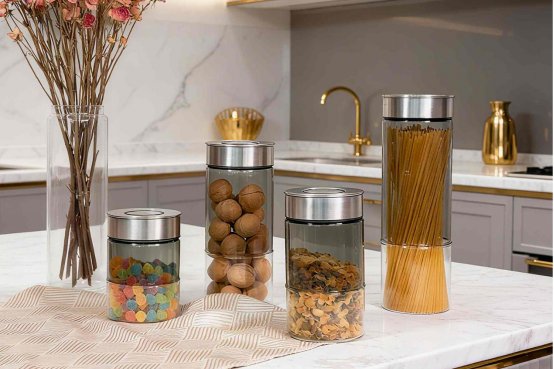
Transparent glass remains a common choice for food storage, seasoning, serving, and drinkware because users can see the contents directly. It also combines naturally with stainless steel, wood, silicone, and other materials.
Differentiation becomes difficult when competing products use similar clear glass bodies, lids, and capacities. In crowded kitchenware categories, small changes in shape may not be enough to create a recognizable product line.
Material choices can therefore become part of product positioning. A commercially viable design must combine functional performance with enough visual consistency to support a distinctive product assortment.
Colored Glass Adds Another Layer of Differentiation
Colored glass provides another way to differentiate familiar products without completely redesigning their structure.
A colored base can create a stronger visual anchor, while a colored neck or upper section can emphasize the pouring or opening area. Different proportions of transparent and colored glass can also change the visual character of the product.
In multi-category kitchenware development, this flexibility allows one visual concept to extend across storage, dispensing, seasoning, grinding, and tabletop products. Color can become a recognizable element across several categories rather than a decorative feature used on only one SKU.
How Material and Craftsmanship Create Product Differentiation
Body-Colored Glass Is Different from Surface Decoration
Colored glass does not always receive its color from a coating applied after production.
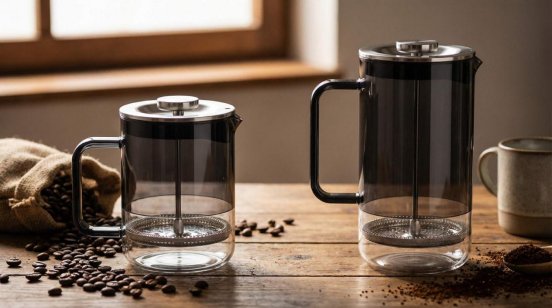
In body-colored glass, selected mineral-based or inorganic colorants are introduced into the glass batch during manufacturing. During high-temperature melting, these components become integrated into the glass matrix, so the color becomes part of the glass rather than a separate surface layer.
This differs from spray-coated or painted glass, where color is applied to the finished surface.
Understanding the coloring method is important because it affects color consistency, sample appearance, and production repeatability. These factors also influence whether a color direction can be reliably adapted across different sizes and product categories during later development.
Clear and Colored Glass Can Work Together
Using colored glass does not mean the entire product needs to become opaque or tinted.
Combining clear and colored sections can be particularly useful for kitchenware because the two areas perform different roles. Transparent glass keeps food or liquid visible, while colored glass creates contrast and visual recognition.
A two-tone glass storage jar is a good example of this approach, using contrasting glass sections to add visual depth to a familiar storage form while preserving the practical visibility of the container.
Craftsmanship Affects More Than Appearance
Once clear and colored glass are combined within the same product, execution becomes important.
The transition position, symmetry, thickness, proportion, and overall balance influence how intentional the finished product looks. If manual forming or joining is involved, some variation may also occur between products.
These details become especially important during product development because a visually successful sample must also be transferable into controlled, repeatable production.
Craftsmanship must also support function. A colored transition should not make a product uncomfortable to hold, difficult to clean, or unstable. Successful product development therefore requires appearance to be evaluated together with grip, balance, pouring, sealing, and other category-specific requirements.
At Aelga, material development is considered together with product structure, function, and manufacturing feasibility. A material idea must work not only at the concept stage, but also through design refinement, prototyping, process development, and repeatable production. This allows product differentiation to be evaluated from both design and manufacturing perspectives before it is scaled into a commercial product.
From One Product Idea to a Multi-SKU Kitchenware Collection
Extending One Material Direction Across Categories
The value of a distinctive material concept becomes greater when it can support more than one product.
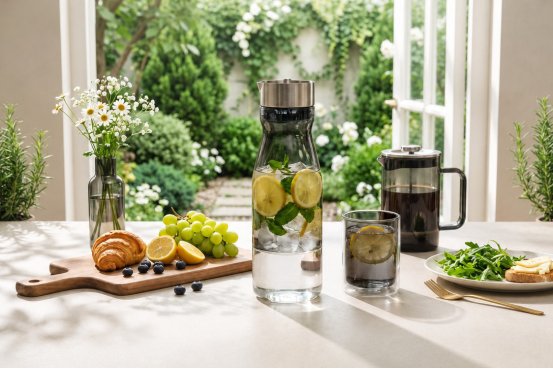
A colored glass detail may begin with one storage jar, but the same concept can later be adapted to an oil dispenser, seasoning container, grinder, honey dispenser, or drinking vessel.
When the same material language can be adapted across several product categories, one successful concept can develop into a coordinated commercial collection rather than remain a single standalone SKU.
The shared element might be one glass tint, a repeated colored base, a particular metal finish, or a consistent transition between transparent and colored areas. These details can create continuity even when the products perform different functions.
A Consistent Material Language Across Different Products
A coordinated kitchenware collection does not require every SKU to share the same silhouette. Each category has different structural and functional priorities: a grinder must support comfortable operation, a storage jar must maintain convenient access and content visibility, while an oil dispenser needs controlled pouring and reliable component integration.
What connects these products is therefore not identical construction, but a consistent material language. A selected glass tint, colored section, stainless-steel finish, or material transition can be adapted according to the scale and function of each product.
This makes a mature material concept easier to extend across multiple SKUs. The proportion and position of colored glass may change from one product to another, while the overall visual identity remains recognizable. For brands, this creates a stronger collection identity without compromising the functional requirements of individual products.
How Aelga Develops Multi-Material Kitchenware Collections
Development Experience Across Kitchenware Categories
Aelga's product portfolio covers multiple kitchenware categories, including storage jars and canisters, oil and vinegar dispensers, spice and condiment products, salt and pepper grinders, food containers, and drinkware. This cross-category experience provides an strong foundation for developing coordinated product collections.
Different products cannot use exactly the same structure simply because they share the same design direction. A storage jar must balance accessibility, sealing, and content visibility; an oil dispenser requires reliable pouring components and grip; while a grinder needs to integrate its operating mechanism with the external form.
Aelga therefore adapts material concepts according to the structure and functional requirements of each category, allowing a shared design language to remain recognizable without compromising product usability.
Material Integration Around Product Structure and Function
Multi-material development requires more than combining attractive materials in one product. Each material must be integrated around the product's structure, operating method, component interfaces, and manufacturing requirements.
In Aelga's product development process, material choices are evaluated together with elements such as bottle shape, lids, dispensing components, surface treatment, assembly requirements, and branding options. The objective is to ensure that the visual concept works with the functional structure rather than being added as a separate decorative layer.
This capability becomes particularly important when one design direction is extended across several categories. The same material language may require different structural solutions in storage, dispensing, grinding, and drinkware products.
From Sampling to Repeatable Production
A distinctive concept creates commercial value only when it can move beyond an initial prototype and into stable production. Aelga supports OEM/ODM projects from concept development and prototyping through manufacturing and quality control, allowing ideas to be evaluated for both design intent and production feasibility.
Once key material, structural, and visual details have been confirmed through sampling, the development can be adapted to additional products while maintaining the essential design language.
This combination of development and manufacturing capabilities allow a successful product concept to grow into a commercially viable multi-SKU kitchenware program.
Conclusion
Colored glass and multi-material design can give familiar kitchenware a stronger visual identity, but successful differentiation depends on more than the material concept itself. The idea must work with product structure, functional requirements, craftsmanship, sampling, and repeatable manufacturing.
For brands and sourcing teams, the value of working with Aelga therefore goes beyond purchasing a distinctive kitchenware product. Aelga combines cross-category product development experience with OEM/ODM support, prototyping, manufacturing, and quality control to help evaluate material ideas, develop workable structures, and verify whether a concept can move into stable production.
This development capability also makes it possible to extend a successful design direction from one product into a coordinated multi-SKU collection while adapting each product to its own functional requirements.
Contact Aelga to discuss colored glass kitchenware sourcing, ODM development, and multi-SKU collection planning.
FAQ
Q: What should buyers check when sourcing colored glass kitchenware?
A: Buyers should understand how the glass receives its color, whether important visual details can be reproduced consistently, and how colored sections interact with other materials. Sample evaluation should also cover balance, grip, cleaning, component fit, and product-specific functions.
Q: Can clear and colored glass be used in the same kitchenware product?
A: Yes. Transparent glass can keep food or liquid visible, while colored glass provides stronger visual differentiation. Combining both can work especially well for storage jars, dispensers, drinkware, and other products where visibility remains important.
Q: Can one colored glass concept be used across several kitchenware products?
A: Yes. Selected elements such as glass tint, colored sections, material transitions, or metal finishes can be extended across several categories while allowing each product to retain the structure required for its specific function.
Q: How does Aelga support ODM kitchenware development?
A: Aelga supports OEM/ODM projects through design consultation, structural evaluation, prototyping, sample confirmation, manufacturing, and quality control. Material, structural, and visual requirements can be evaluated together so that a concept is not only visually distinctive but also suitable for repeatable commercial production.