


Why Glass Storage Jars Are Becoming Central to Modern Kitchen Organization
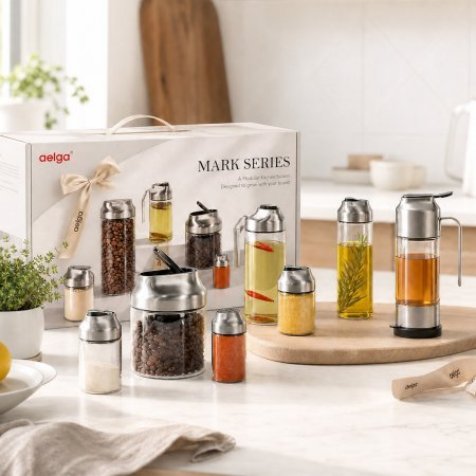
Glass storage jars are becoming central to modern kitchen organization because they solve three practical problems at once: visibility, freshness, and long-term material confidence. Aelga approaches this shift through glass storage jars that combine transparent bodies, airtight lid structures, silicone sealing details, and coordinated kitchenware categories.
Why Glass Storage Jars Fit the Shift Toward Cleaner Kitchen Systems
Transparency, Materials, and Everyday Visibility
Clear glass remains one of the most useful materials for ingredient storage because it removes guesswork. Users can check fill levels, identify contents, and notice moisture or clumping before food quality declines. That matters in compact kitchens where ingredients are stacked in cabinets, displayed on counters, or arranged in open shelving.
Aelga emphasizes borosilicate glass in several storage products, while materials also distinguish soda-lime glass for selected stainless-steel-sleeved jars. That distinction matters: material choice should match the product form, intended ingredient, lid structure, and price position rather than being treated as a generic claim.
Airtight Storage as a Freshness Design Problem
Airtight glass storage jars are useful because dry ingredients are sensitive to air, moisture, odor transfer, and messy handling. A lid with a silicone sealing ring can help reduce exposure and keep the jar suitable for coffee beans, tea, spices, sugar, nuts, candy, grains, and similar dry foods.
The Aelga glass kitchen storage jar describes a borosilicate glass container with an airtight lid for dry food, spices, and coffee beans. That positioning is well aligned with current kitchen organization behavior: users want containers that are easy to recognize and easy to group.
How Aelga Builds Practical Glass Storage Jars
Press Lid Sealing and Silicone Ring Details
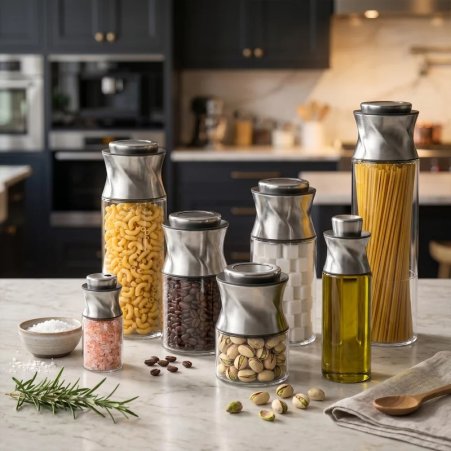
One-click or press-type sealing as a recurring Aelga storage jar feature. A simple press creates a tighter lid position, while a silicone sealing ring supports the barrier between the container and outside air. For daily use, that mechanism can be more intuitive than screw caps.
Borosilicate Glass, Soda-Lime Glass, and Stainless Steel Choices
Borosilicate glass plays an important role in several Aelga storage and dispensing products, including glass kitchen storage jars and tilt-pour storage canisters. Selected lines also combine stainless steel lids or stainless steel outer sleeves with glass bodies and silicone sealing rings. This material mix gives Aelga a recognizable design language: transparent storage, reliable sealing details, and metal accents that feel more structured than ordinary plastic containers.
Aelga's tilt-pour glass storage canister adds another useful detail: an integrated tilt function in the lid for direct dosing and pouring. That feature moves the jar from passive storage into controlled dispensing, which is valuable for oats, grains, coffee beans, and other dry pantry ingredients handled in measured amounts.
Capacity Planning for Modern Pantry Use
Small Jars for Tea, Coffee, Candy, and Spices
Capacity planning is one of the most overlooked parts of pantry organization. A small jar is not automatically better because it saves space; it is better when the refill rhythm matches the ingredient.
Tea, coffee beans, candy, spices, and nuts often benefit from smaller or medium jars because they need quick access and clear identification. Larger jars make more sense for oats, flour, grains, or dry snacks that are refilled in bigger batches.
Storage That Looks Organized Without Hiding the Ingredient
Modern kitchen storage increasingly favors visible order rather than concealed clutter. Glass storage jars help because the ingredient itself becomes part of the visual system. A matching lid design and repeated height logic can make a shelf look planned even when it holds different food categories.
Aelga's range supports this idea by connecting storage jars with spice shakers, oil and vinegar dispensers, and other table-use items. The result is a coordinated kitchenware language that can expand with the household instead of forcing users to change systems later.
Beyond Jars: Matching Storage With Dispensing Products
Oil and Vinegar Dispensers for Cleaner Counters
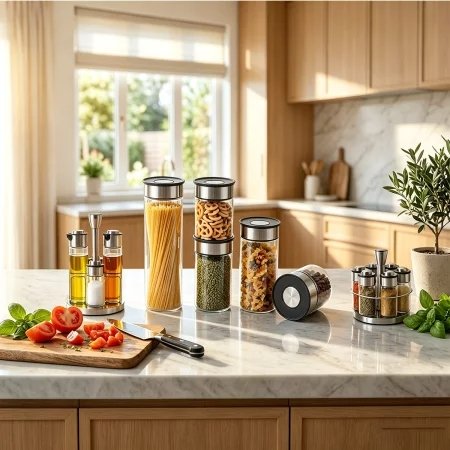
A kitchen storage system becomes more convincing when dry storage and liquid dispensing share the same design logic. Aelga's oil and vinegar products extend the glass-and-metal theme into olive oil, vinegar, soy sauce, and similar liquids. The oil bottles are in the 200ml to 400ml range.
The Aelga oil and vinegar dispenser is especially relevant for kitchens where clean pouring and easy refilling matter. A silicone-sealed gasket inside the cap helps avoid leakage and spillage, while the wide opening supports easier cleaning.
Spice Shakers With Adjustable Flow Control
Spice storage has a different problem: the container must store, seal, and dispense in very small quantities. Aelga’s spice bottles have rotating caps and different outlet sizes for seasonings such as salt, pepper, chili powder, and cumin powder.
That level of detail is useful because flow control shapes the cooking experience. Fine salt, coarse herbs, grated cheese, and powdered spices do not behave the same way. Adjustable dispensing turns the spice jar from a decorative accessory into a more flexible tool for real food preparation.
What Buyers Should Look for in a Kitchen Storage System
Material Specificity, Lid Design, and Real Use Cases
A set of glass storage jars can be judged on the basis of material specificity, performance of the lid, logic of capacity, and categorization. Consumers should seek specific mention of borosilicate glass, soda lime glass, stainless steel, silicone, and PP where these materials are truly used.
The lid must also be given its due consideration. There are various issues that need to be solved using different types of lids, including press lid, tilt pour lid, sliding spice lid, and stainless steel pouring spout.
Conclusion
Glass storage jars have moved from basic pantry containers to an important part of modern kitchen planning. Their value comes from transparent ingredient visibility, airtight lid design, and the ability to coordinate with spice, oil, vinegar, and meal-prep products. Aelga's strength is that its product details support this broader system view through glass, stainless steel, silicone, press lids, tilt-pour structures, and clean dispensing formats.
Explore Aelga's kitchen storage and dispensing solutions to build a more organized, durable, and visually consistent product lineup.
FAQ
Q: Are glass storage jars better than plastic containers for pantry organization?
A: Glass jars for storage are usually recommended in pantries because they allow you to see through the contents of the jars, do not absorb smells, and fit nicely for display on shelves and countertops. Plastic is generally lighter, but glass is more sturdy and fits nicely for display.
Q: What can I store in airtight glass storage jars?
A: The airtight glass jars may be used for storing several dry products such as coffee beans, tea leaves, spices, sugar, nuts, candies, cereals, oats, and other kitchen supplies. Glass jars will prove helpful in situations where the lid helps minimize the amount of air and moisture. Liquid containers need a different type of product.
Q: Why does lid design matter for kitchen storage jars?
A: The lid helps preserve the freshness of the food inside, makes using the jar convenient, and ensures the jar is closed properly every time it is used. There are many types of lid designs that can address different issues. The lid should be made in such a way that opening, closing, dispensing, and cleaning the jar is convenient.