


Why Private-Label Buyers Are Rethinking Kitchenware Systems
Private-label buyers are rethinking kitchenware because coordinated systems create more value than isolated products. A system aligns materials, functions, capacities, finishes, and future extensions, helping buyers build assortments that are easier to position and manage. The purchasing decision therefore shifts from finding an attractive jar or bottle to selecting a development partner that can connect design with repeatable production.
This approach is especially relevant to storage jars, seasoning containers, and oil dispensers, whose commercial value depends not only on appearance but also on reliable sealing, controlled dispensing, suitable material selection, and consistent design across the product range. For buyers seeking coordinated glass and stainless steel kitchenware, Aelga provides an integrated solution that helps maintain functional performance, visual consistency, and repeatable production.
Why Kitchenware Systems Matter to B2B Buyers
A stand-alone product may perform well but still be difficult to scale into a retail program. Its proportions may not coordinate with other sizes, its finish may be hard to reproduce across categories, or its structure may not support a logical extension. These issues affect shelf presentation, assortment planning, packaging, and repeat purchasing.
A kitchenware system gives each item a defined role within a common design language. Storage jars can use several heights for different pantry needs, while seasoning jars and oil bottles can carry related material and finish cues. Buyers gain a collection that is easier to explain to distributors and easier to expand when a channel requests new functions.
Reviewing a supplier's kitchenware product portfolio helps a buyer judge whether categories can work together instead of merely counting available products. The key question is whether the products share a coherent architecture that can support a recognizable private-label range.
Structural Performance Shapes Kitchenware Value
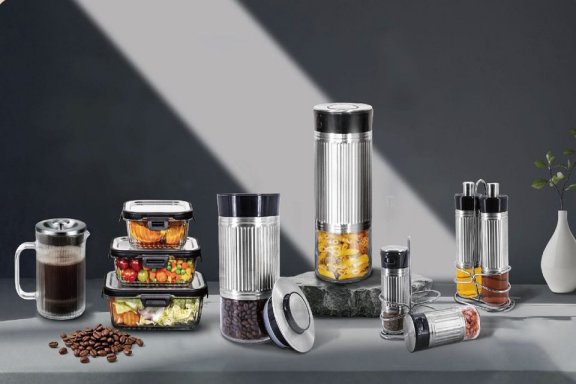
Visual design attracts attention, but structural performance often determines whether a product remains viable after sampling. Storage lids, rotating seasoning tops, and pouring spouts all rely on interfaces between components. Small inconsistencies at those interfaces can weaken usability or make one item feel noticeably different from the rest of the collection.
Sealing Must Balance Protection and Access
Aelga storage jars use effective sealing and a distinctive press-lid design for convenient access. For a buyer, the relevant decision is not the claim alone, but how the lid feels and fits across the proposed range. Samples should be reviewed for closing consistency, ease of opening, component alignment, and suitability for the intended dry-food storage scenario.
The press mechanism should also be considered as part of the product family's visual and functional identity. If several jar heights share a related lid concept, the collection can appear more deliberate on the shelf. However, the buyer should confirm that shared styling does not create awkward proportions or handling differences between sizes.
Dispensing Details Influence Daily Perception
Oil bottles and seasoning jars demonstrate how small functions influence perceived quality. Aelga oil spouts are designed for convenient pouring with less residue and reduced exposure to dust, while seasoning lids can adjust the outlet size for different seasonings. These details help a buyer compare products on practical use rather than appearance alone.
During selection, the oil bottle should be assessed for flow control, refill access, and cleaning convenience. The seasoning jar should be reviewed for lid rotation, outlet alignment, and suitability for the expected particle sizes. A coordinated look is valuable, but each product still needs a structure suited to its specific task.
Material Choices Should Match Market Position
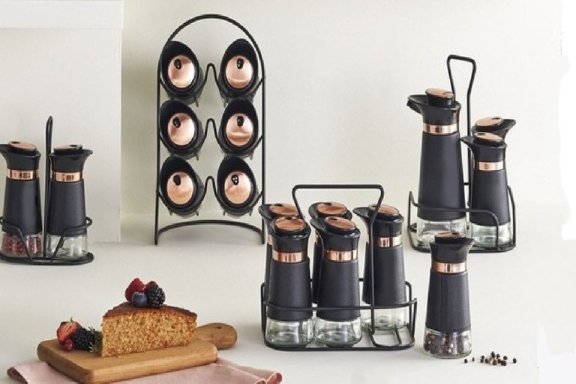
Aelga uses two relevant material approaches for these storage products. Sleeved products can combine soda-lime glass with 201 stainless steel covers and lids, while unsleeved products can use high-borosilicate glass. These constructions create different appearances and should be evaluated according to product structure, intended use, target price position, and desired shelf presence.
A stainless steel sleeve can add a stronger metallic visual identity and coordinate with related dispensing products. An unsleeved glass body places more emphasis on transparency and the stored contents. Neither approach should be treated as universally superior; the better choice is the one that supports the buyer's positioning and can be applied consistently across the planned assortment.
Capacity Planning Builds a Sellable Range
Capacity planning is where a product list becomes an assortment. Aelga storage jars are offered in several heights, seasoning jars are generally around 120 ml, and oil bottles commonly range from about 200 ml to 400 ml. This provides a practical starting point for assigning clear functions across a storage and dispensing collection.
For buyers, each size should answer a distinct storage or dispensing need. Too many closely spaced capacities can increase inventory and packaging complexity without improving consumer choice, while too few can leave obvious use cases uncovered. A stronger range usually combines clear functional roles with a visually coherent progression.
OEM and ODM Decisions Begin Before Quotation
A productive OEM or ODM project starts with a commercial brief rather than a request for the lowest unit price. Buyers should define the target channel, intended user, preferred product categories, material direction, capacity structure, visual positioning, packaging expectations, and branding needs. These inputs allow feasibility and assortment logic to be considered before details become expensive to change.
Evaluate Development Fit
The first supplier question should be whether the proposed concept can become a consistent family. Buyers can ask how storage, seasoning, and dispensing products will share design cues while retaining function-specific structures. Aelga is relevant when the requirement centers on multi-material integration and systematic product-line development.
Review Samples as a Collection
Buyers should compare glass color, metal finish, lid proportions, logo location, opening behavior, and packaging scale across the full sample set. Any intended difference should support a clear functional or price-level purpose.
The same review should identify which elements are fixed and which remain customizable. Aelga can contribute solution options.

Conclusion
Kitchenware sourcing is shifting from isolated product selection toward coordinated system development. The strongest purchasing decisions connect sealing and dispensing functions, verified material choices, capacity planning, visual consistency, and a realistic path for OEM or ODM execution. This creates an assortment that is easier to position, extend, and manage.
Aelga can support buyers seeking coordinated glass and stainless steel kitchenware across storage, seasoning, and dispensing categories.
Contact Aelga to discuss a coordinated kitchenware solution tailored to your product range and target market.
FAQ
Q: What should buyers check first when sourcing kitchenware systems?
A: Buyers should first define the target channel, users, product categories, material direction, and required functions. They can then compare suppliers on assortment logic, sample consistency, sealing or dispensing usability, packaging fit, and customization scope. This prevents an attractive individual product from driving a range that lacks a coherent commercial structure.
Q: How can buyers assess airtight storage jars without relying on claims?
A: Buyers should inspect actual samples for lid fit, closing consistency, ease of opening, component alignment, and suitability for the intended dry-food application. Several proposed jar sizes should be tested side by side because a lid concept may feel different across proportions. The approved construction and acceptance points should be recorded before production.
Q: Which material options are verified for Aelga storage products?
A: Certain sleeved Aelga storage products combine soda-lime glass with 201 stainless steel covers and lids, while unsleeved products can use high-borosilicate glass. Buyers should select between them according to structure, appearance, intended use, target price position, and applicable market requirements. The final specification should then be confirmed through samples and documentation.
Q: What information helps Aelga prepare an OEM or ODM proposal?
A: A useful brief includes the sales channel, target user, required categories, preferred materials, capacity plan, visual direction, branding, packaging expectations, and quality priorities. Buyers should also identify which features are essential and which are optional. This gives Aelga a clearer basis for proposing a coordinated and commercially manageable kitchenware solution.